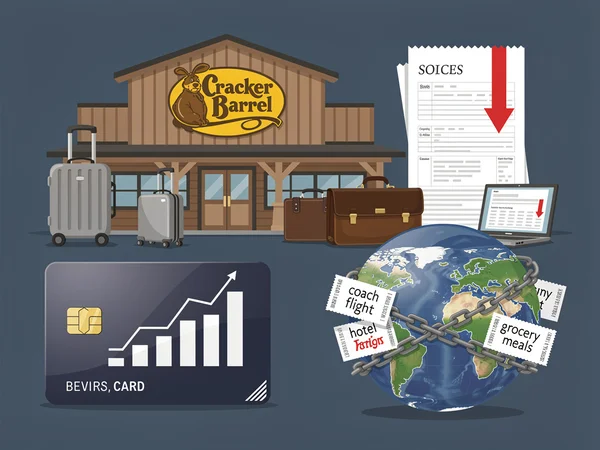
The message from Cracker Barrel management landed like a stale biscuit amid the chain’s sales slump. Employees were told to delay work trips until later this year. If travel proved unavoidable, they should stick to the company’s meatloaf and country fried steak for meals. “Employees are expected to dine at a Cracker Barrel store for all or the majority of meals while traveling, whenever practical based on location and schedule,” the internal directive stated, as reported by the Wall Street Journal .
This policy exemplifies a broader shift dubbed “travelscrimping,” where firms across America scrutinize road warrior outlays. After years of austerity, business journeys shed their last vestiges of allure, forcing staff to hunt $100 hotel rooms, assemble grocery meals, and visit laundromats instead of using hotel services.
Cracker Barrel also banned company reimbursement for alcohol on trips, requiring personal payment unless pre-approved for special occasions by executives. Recent layoffs at the chain made some employees dismissive, noting they rarely drank on the road anyway, given alcohol’s recent addition to menus.
Advertisement
article-ad-01Tightening the Reins on Road Costs
A Corporate Business Travel analysis of the SAP Concur Global Business Travel Research Report revealed steady budgets but rising employee expectations to shoulder more costs. Justin Salerno, a Milwaukee engineer at an acquired aerospace startup, now adheres to federal per diem rates for lodging and meals. In Utah, he caps rooms at $110 nightly, occasionally exceeding during events and justifying overruns.
“I’m a bit loosey goosey about it,” Salerno admitted. Finance leaders like Jeff Oscarson in construction have rejected odd claims, such as $500 wine bottles, jeans pairs, and chairs. “Why would you do something to poke the bear by expensing a chair?” he asked.
Amazon’s longstanding frugality pushes coach seats, sparking debates on thresholds like height for international business class. David Markley, a former Amazon executive coach, endured long-haul coach flights from Seattle to Europe, Japan, and Bengaluru, avoiding bulkheads due to bassinets. “When one baby wakes up, they all tend to wake up,” he said.
Survival Tactics for Budget Journeys
Travelers forage groceries for hotel assembly or ration allowances for dinners. Chicago consultant Leroy Craighead skips Starbucks beyond coffee, opts for sparse lunches, and leverages hotel loyalty lounges. “There’s tricks,” he said. European firms prove stingier; consultant Michael Paci charges $50 steaks casually, but colleagues receipt drip coffee for two euros reimbursements. “They are going to get you two euros at a time. There is a degree of absurdity,” Paci noted.
Ex-consultant Joe Fenti quit amid reimbursement drudgery, turning it into comedy. His skit mocks policy changes via “smoke signals and bird calls,” with employees fumbling codes in desperation.
Cracker Barrel’s directive coincides with fiscal pressures, including plans to shutter 14 Maple Street Biscuit units in fiscal 2026 after impairments, per FSR magazine . Broader trends show 30% of travelers facing premium seat cuts, fewer overnights, and nonstop reluctance, according to the Concur report.
Frugality’s Roots in Tough Times
Expense abuse justifies scrutiny; companies cap amid economic strain. Per diem simplifies but tests bargain skills. As 2026 looms, TCJA expirations threaten meal deductions—50% now, potentially zero post-2025 for employer-provided meals, noted in analyses from Forvis Mazars and others.
Travelers adapt with early bookings, rideshares, and policy adherence. CBTravel’s report shows 89% of travelers, 93% of managers, and 90% of CFOs foresee no budget slashes, yet costs climb, prompting consolidation.
Cracker Barrel’s self-dining rule, while extreme, mirrors this penny-pinching ethos, blending cost control with brand loyalty in a squeezed market.

LEAVE A REPLY
Your email address will not be published