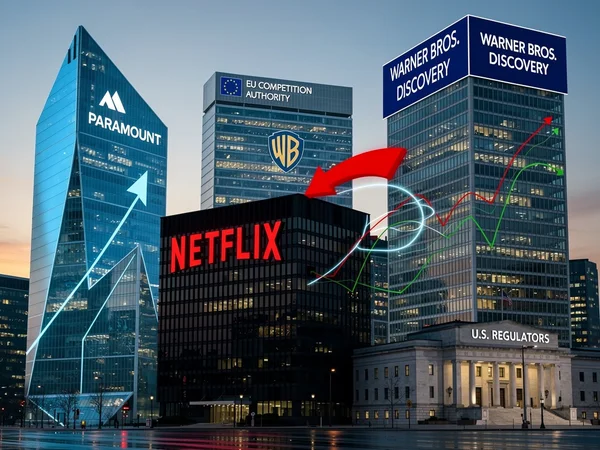
Paramount Global and its Skydance Media backers are pinning their hopes on European antitrust enforcers to derail Netflix’s aggressive pursuit of Warner Bros. Discovery, setting the stage for one of the most contentious media mergers in years. As Warner Bros. Discovery’s board rallies behind an all-cash $83 billion Netflix offer, Paramount is mounting a regulatory offensive, arguing the deal would stifle competition across streaming and content production in Europe. The strategy hinges on Brussels’ scrutiny, where officials are poised to review both bids simultaneously—a rare dual-track probe that could reshape Hollywood’s power structure.
Warner Bros. Discovery, still grappling with debt from its 2022 merger, has twice rebuffed Paramount’s hostile $108.4 billion tender offer, favoring Netflix’s sweetened proposal at $27.75 per share. Netflix’s shift to all-cash from a cash-and-stock mix has won unanimous board support at WBD, accelerating a shareholder vote slated for April. Yet Paramount, led by David Ellison and backed by Larry Ellison’s personal guarantee, is extending its bid and lobbying regulators on both sides of the Atlantic.
Advertisement
article-ad-01Brussels Enters the Fray
European Union antitrust authorities plan to evaluate Netflix’s and Paramount’s rival bids for Warner Bros. Discovery at the same time, according to Reuters citing Bloomberg News. This unusual head-to-head review could delay approvals and expose vulnerabilities in Netflix’s dominance, particularly in sports rights and local content markets. Paramount’s chief legal officer, Makan Delrahim, has publicly questioned how regulators could greenlight the Netflix tie-up, posting on social media that it raises insurmountable antitrust hurdles.
The CNBC analysis underscores Paramount’s calculus: EU regulators, wary of Big Tech consolidation, might view Netflix absorbing WBD’s studios and streaming assets—Max among them—as a threat to market diversity. “Paramount is counting on European regulatory backlash to push the WBD deal away from Netflix,” CNBC reported, detailing scenarios where Brussels demands divestitures or outright blocks the merger ( CNBC ).
Netflix’s Aggressive Pivot
Netflix upped the ante last week with its all-cash revamp, aiming to sideline Paramount and fast-track closure. The bid targets WBD’s studio, streaming, and networks divisions, leaving its linear TV and debt burdens behind. “Netflix will pay all cash for the $83 billion deal,” The New York Times noted, highlighting the proposal’s appeal to shareholders seeking liquidity amid WBD’s volatile stock performance.
WBD’s rejection of Paramount’s latest overture came swiftly, with the board deeming Netflix superior despite Paramount’s $30-per-share all-cash tease and Ellison family backing. “Warner Bros. Discovery’s board still sees its deal with Netflix as the superior option,” per an earlier CNBC update. Posts on X reflect industry buzz, with analysts like those at The Capitol Forum noting Paramount’s push for early EU clearance to preempt Netflix’s vote.
Paramount’s Multi-Front Assault
Beyond Europe, Paramount has urged U.S. lawmakers to deem the Netflix-WBD merger unlawful, arguing Netflix’s market definitions are “absurd,” as reported by Deadline . A federal judge recently denied Paramount’s bid to compel WBD disclosures on the Netflix talks, but the company vows to extend its tender offer past January 21. David Ellison faces mounting pressure, with TheWrap analyzing his limited options as shareholders eye Netflix.
In the UK and France, Paramount is courting politicians with pitches on cinema preservation and competition, per X discussions from media insiders. Sovereign wealth funds loom as potential backstops, though Paramount’s initial bid omitted firm cash commitments from them. RedBird Capital and banks like Bank of America provide financing, but regulatory roulette defines the endgame.
U.S. Regulators Weigh In
While EU focus sharpens, U.S. Department of Justice and FTC scrutiny looms large. Paramount’s letter to House antitrust leaders frames Netflix’s power in premium video—bolstered by WBD’s HBO and sports assets—as anticompetitive. Warner Bros. has criticized Paramount’s sports spending, like UFC rights, as fiscally reckless, a point echoed in X posts from deal trackers.
Netflix’s global scale, with over 300 million subscribers, amplifies concerns. Acquiring WBD’s content pipeline could entrench pricing power and squeeze independents, regulators fear. Bloomberg-reported EU parallelism signals coordinated transatlantic reviews, potentially stretching into mid-2026.
Shareholder Dynamics Shift
WBD investors face a pivotal April vote on Netflix, but Paramount’s tender extension keeps pressure on. The all-cash Netflix premium—about 40% above recent trading—tempts, yet antitrust risks linger. The Guardian reports Netflix touting faster completion, allowing votes sooner.
Analysts on X, including Wall St Engine, highlight WBD’s debt aversion to Paramount’s structure. Paramount’s credit rating and funding opacity fueled rejections, positioning Netflix as the steadier path—unless Brussels intervenes.
Strategic Content Clash
At stake: troves of IP from DC Comics to CNN, plus Max’s 100 million users merging with Netflix’s base. Paramount eyes synergies with CBS and Skydance’s animation, but WBD balks at integration risks. Media Play News quotes Delrahim doubting Netflix clearance.
Sports rights—NFL, NBA, UFC—underscore tensions, with Netflix’s cash hoard enabling bids Paramount matches expensively. European markets, vital for local quotas, amplify regulatory stakes.
Endgame Scenarios Emerge
If EU blocks Netflix, Paramount pounces; approval flips leverage. Divestitures—like peeling off Eurosport—could satisfy watchdogs. X sentiment tilts toward prolonged drama, with users predicting WBD ‘ends up with bupkis’ sans deal.
For industry insiders, this triad battle tests post-streaming-war consolidation limits, with billions in play and Hollywood’s future hinging on regulators’ calls.

LEAVE A REPLY
Your email address will not be published