



Wander With Wonder contains affiliate links and is a member of the Amazon Services LLC Associates Program. If you make a purchase using one of these Amazon or other affiliate links, we may receive compensation at no extra cost to you. See our Disclosure Policy for more information.
Outdoor enthusiasts flock to St. Marks National Wildlife Refuge for fishing, bird-watching, hiking, biking, and picnicking.
The tram eased down the paved route along the Lighthouse Road. Past hardwood swamps and original slash pine woodland planted in 1931 when the St. Marks National Wildlife Refuge was first established…past countless sabal palm trees and twisted live oaks. A sanctuary known for its wealth of birds and gators, some 70,000 nature-protected acres follow the Panhandle’s coastline, barely 25 miles from Florida’s capital of Tallahassee. Right off US-98, just west of St. Marks, you’ll find wetlands of black gum and swamp maples…boggy zones of reeds fed by the tides…and forests of Southern Florida pines, valued for their prized timber, resin, and turpentine.
Outdoor enthusiasts flock to the Refuge for fishing, controlled hunting, bird-watching, hiking, biking, and picnicking. And they come to tour the historic St. Marks watchtower perched at the mouth of the St. Marks River and Apalachee Bay. Travel with me to my home state of Florida to explore outdoor adventures awaiting at St. Marks National Wildlife Refuge.
Birding Tours at St. Marks National Wildlife Refuge
My husband and I were ‘newbie’ birders on our first trip to St. Marks National Wildlife Refuge. We were only capable of identifying a few shorebirds—regal Great Blue Herons, Cattle Egrets astride livestock, and Snowy Egrets, with their distinctive saffron-yellow feet. But we had the pre-requisite “Birds of Florida” handbook and were determined to learn.
It wasn’t easy hanging over the side with our binoculars in play, trying not to lose an eyeball every time the tramcar hit a bump. In fact, it was nothing short of intimidating, being surrounded by our professional guide and at least twenty accomplished birders.
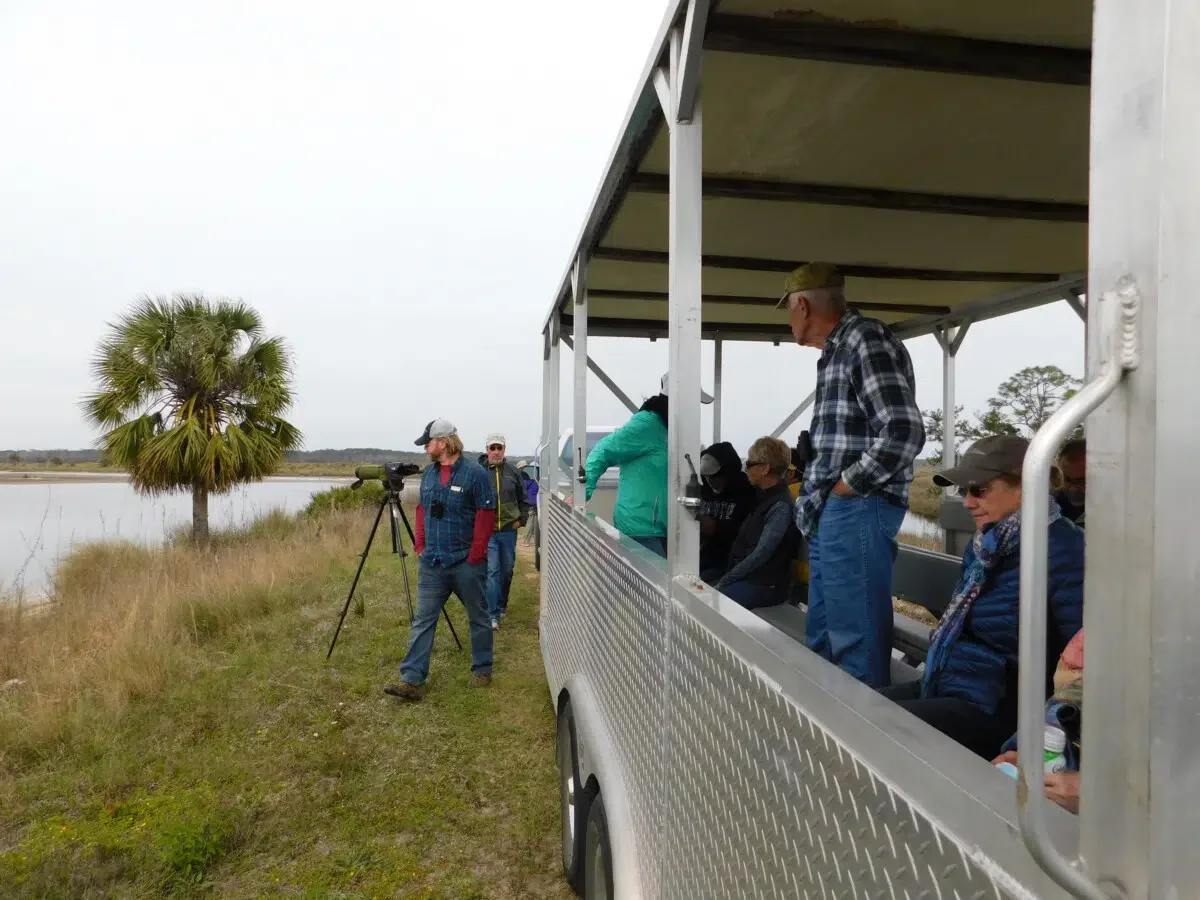
It was a bit intimidating for my husband and me, being on the tram with a professional guide and dozens of other long-time birders. Here, they’ve set up powerful binoculars to check out the avian wildlife at the Mounds Pools. Photo by Gustavo Lillo
Fishing and Family Fun at St. Marks Wildlife Refuge
Rain lilies and blue flag irises bloomed near the freshwater impoundments—perfect not only for seasonal and resident waterfowl but also for year-round fishing. Anglers regularly caught redfish and large-mouth bass, only too happy to frequent the marshy bays and estuaries of the Gulf of Mexico, darting amongst its extensive fields of sawgrass.
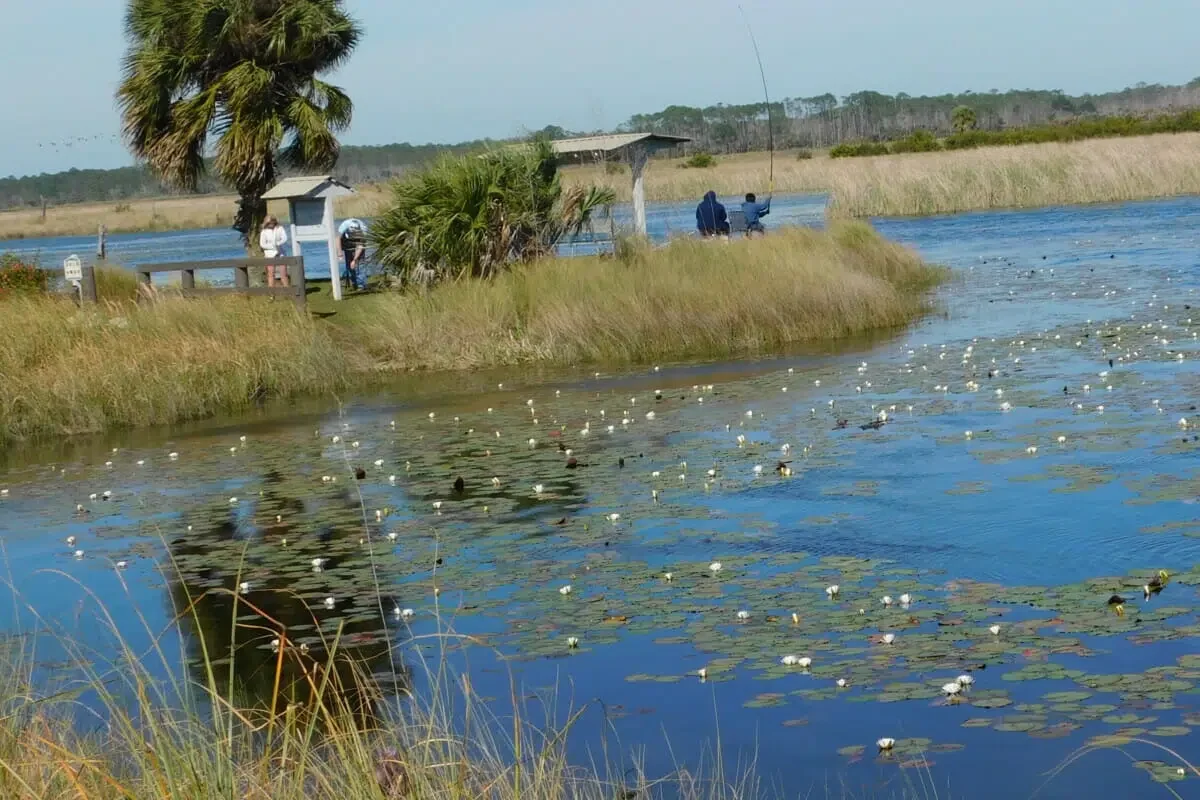
A couple of anglers, sharing a bream-buster pole, fish in the freshwater pools at St. Marks Refuge, trying not to get their hook tangled in the clusters of blossoming lilies. Photo by Gustavo Lillo
For a day of family fun, just pack a basket of vittles, grab your reel-and-rods, and enjoy an afternoon inhaling the fresh salty marine air, listening to the chatter of songbirds and the sound of red drums thrashing on the end of your line.
St. Marks Refuge is a Stop on the Great Florida Birding Trail
The morning of our visit, however, we weren’t there for fishing. We were there to check out the birds. Like the Reserve’s Bald Eagles that frequent Mounds Pool #3, which is distinguishable from the other ponds for the naked pines – leafless and branchless – that stove up out of the water like jagged ski poles for a cyclops. The landscape is the result of invading saltwater from 2005’s Hurricane Dennis that made landfall 195 miles away.
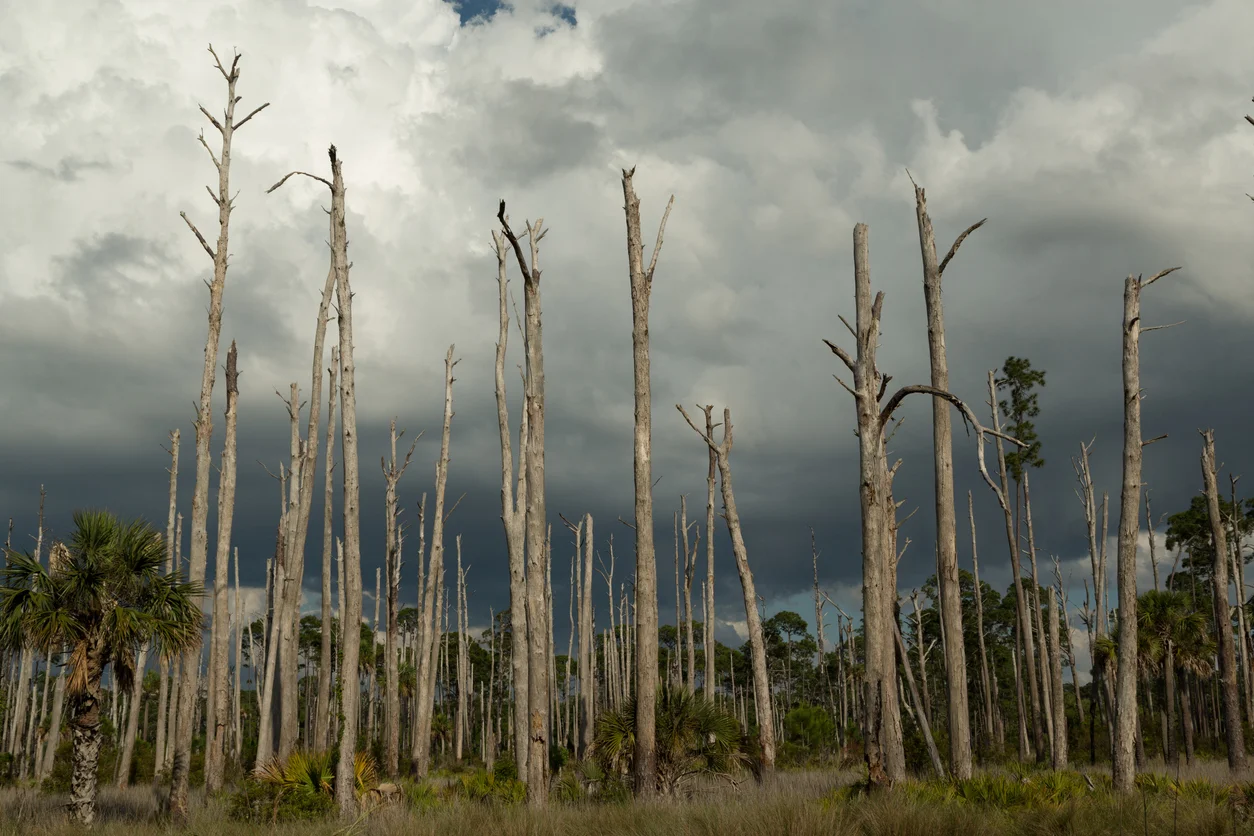
St. Marks National Wildlife Refuge near Tallahassee, Florida. Photo by stephenallen75 via iStock by Getty Images
Birds Galore at Tower Pond in St. Marks National Refuge
“This time of year,” noted Don Morrow, a volunteer who’s been leading birdwatching excursions for over 20 years, “there would normally be about 2,000 ducks at the preserve around January.”
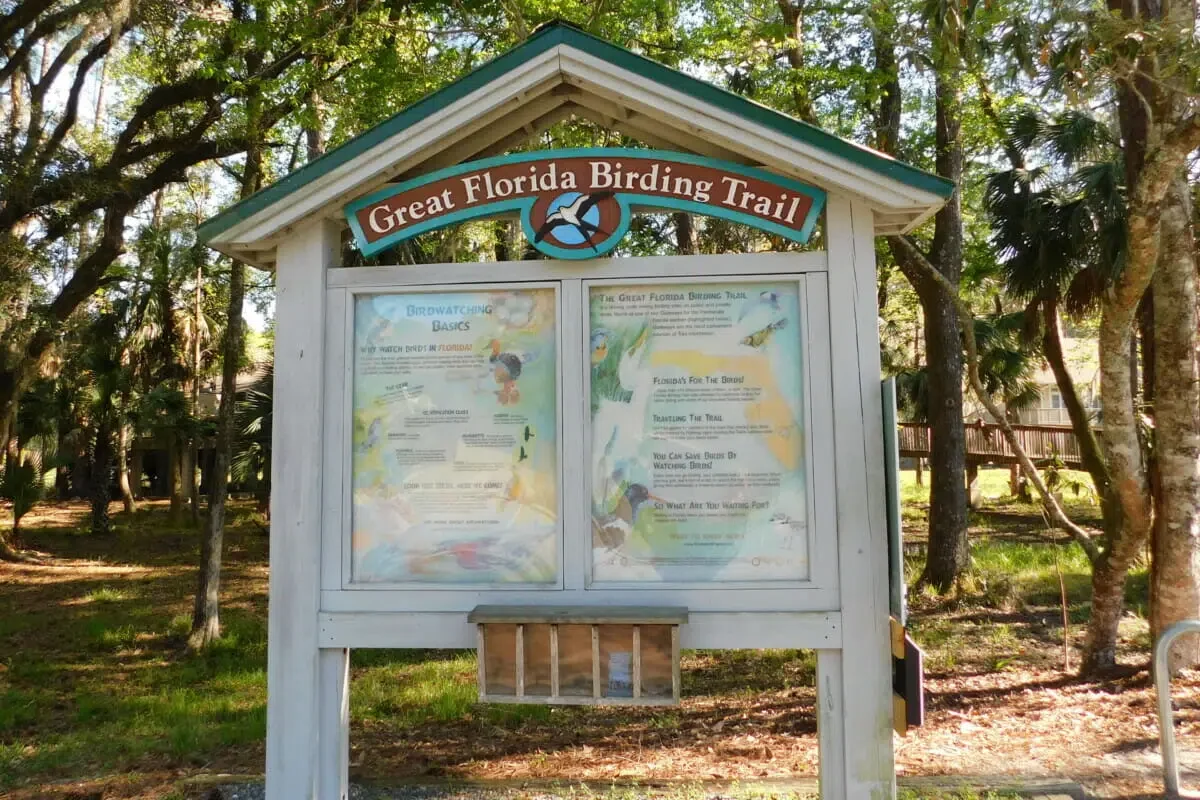
The St. Marks Wildlife Refuge is part of the Great Florida Birding Trail, as a stop on the flight south for migrating winter birds, as well as dozens of resident nesters. Photo by Gustavo Lillo
Inexplicably, many of the drakes and hens migrated early, flying north. Going home. “Basically, they’ve left these nesting eagles in a lurch. The successful breeding eagles are still here, with their fledglings. They dine on ducks, so it’s like Publix [the supermarket giant of the southeast] just left. Their groceries are gone. But they can’t leave yet, because they’ve still got kids to raise.”
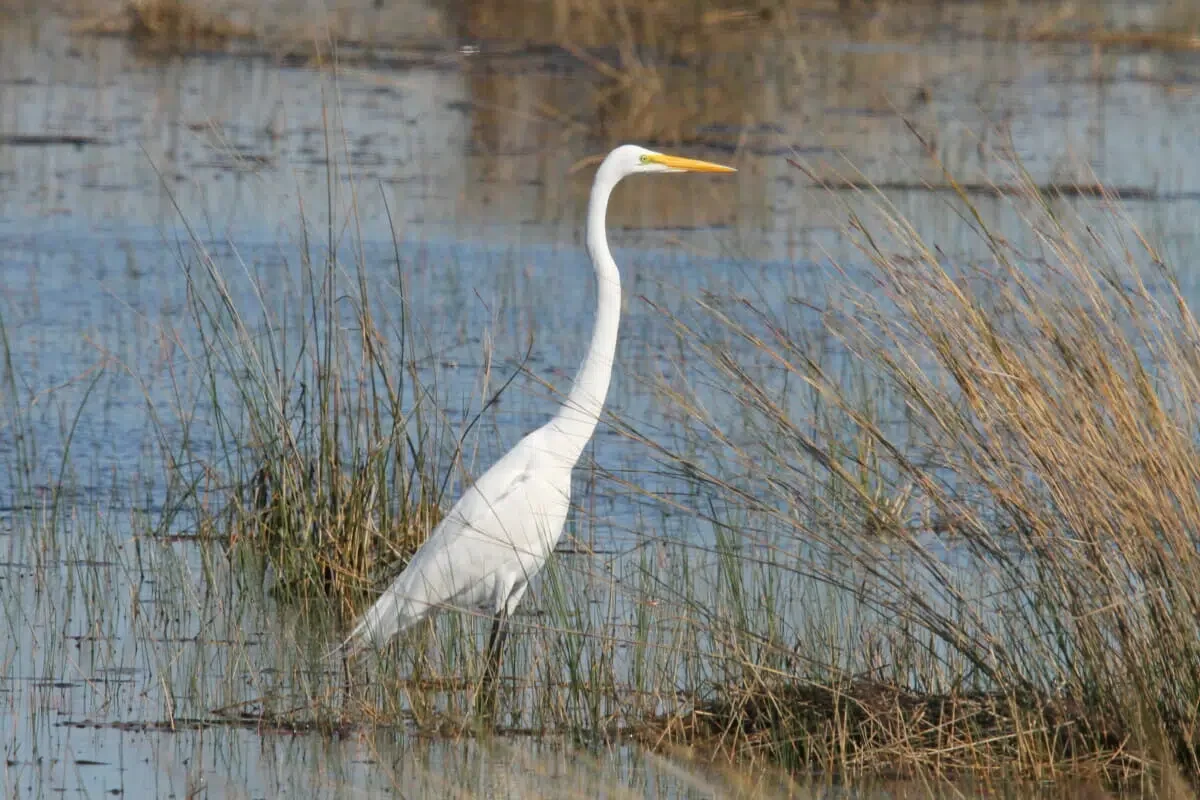
With saltwater from the adjacent Gulf and freshwater inlets, the lagoon is the perfect place for a foraging Great egret. Photo by Gustavo Lillo
The trolley approached Tower and Picnic Ponds, once seawater pools now managed as brackish lagoons, mixed with salt- and fresh-water.
“High tide is a good time to see shorebirds,” Morrow explained. “They come inland for food until the tide recedes and exposes the mudflats. Just so you know…I have birder’s attention deficit disorder, so if I get excited, we’ll have to stop and see something.”
I was excited, anticipating the sighting of lanky waders, such as Greater and Lesser Yellowlegs, Dunlins, and Semi-palmated Plovers, feeding on crustaceans caught in the brine.
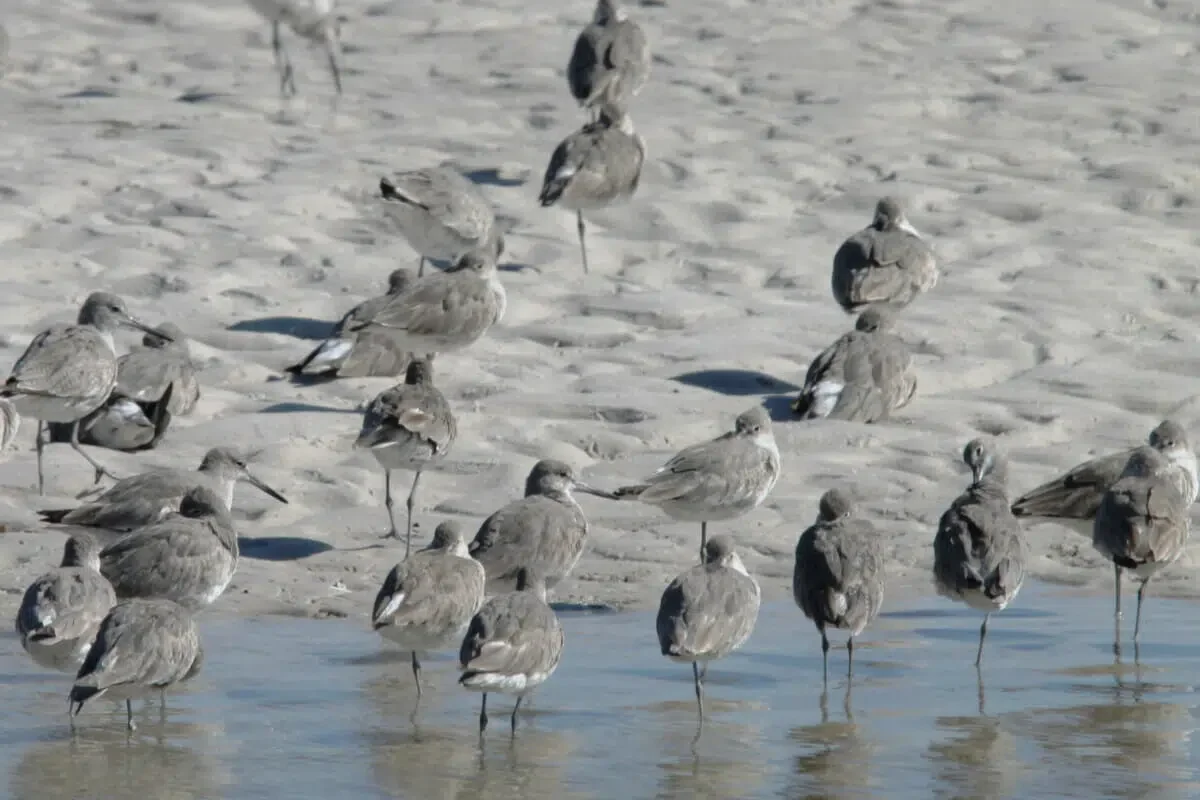
Dunlins taking a rest at the Tower Pond, some balanced on one foot. Photo by Gustavo Lillo.
Pelicans and Shorebirds Line the Pilings near St. Marks Lighthouse
Nearby Headquarters Pond was a’flurry with winged prey—Lesser Scaups, American Coots, and Purple Gallinules with their bright red-and-yellow beaks that resemble candy corn. All were splashing in the reservoir, occasionally munching on tri-leafed duckweed plants skimming the surface. Quacking and feather ‘displaying’ ensued, but none of it seemed to faze Shelby Bauer, a Refuge intern busily sketching the birds in a notebook.
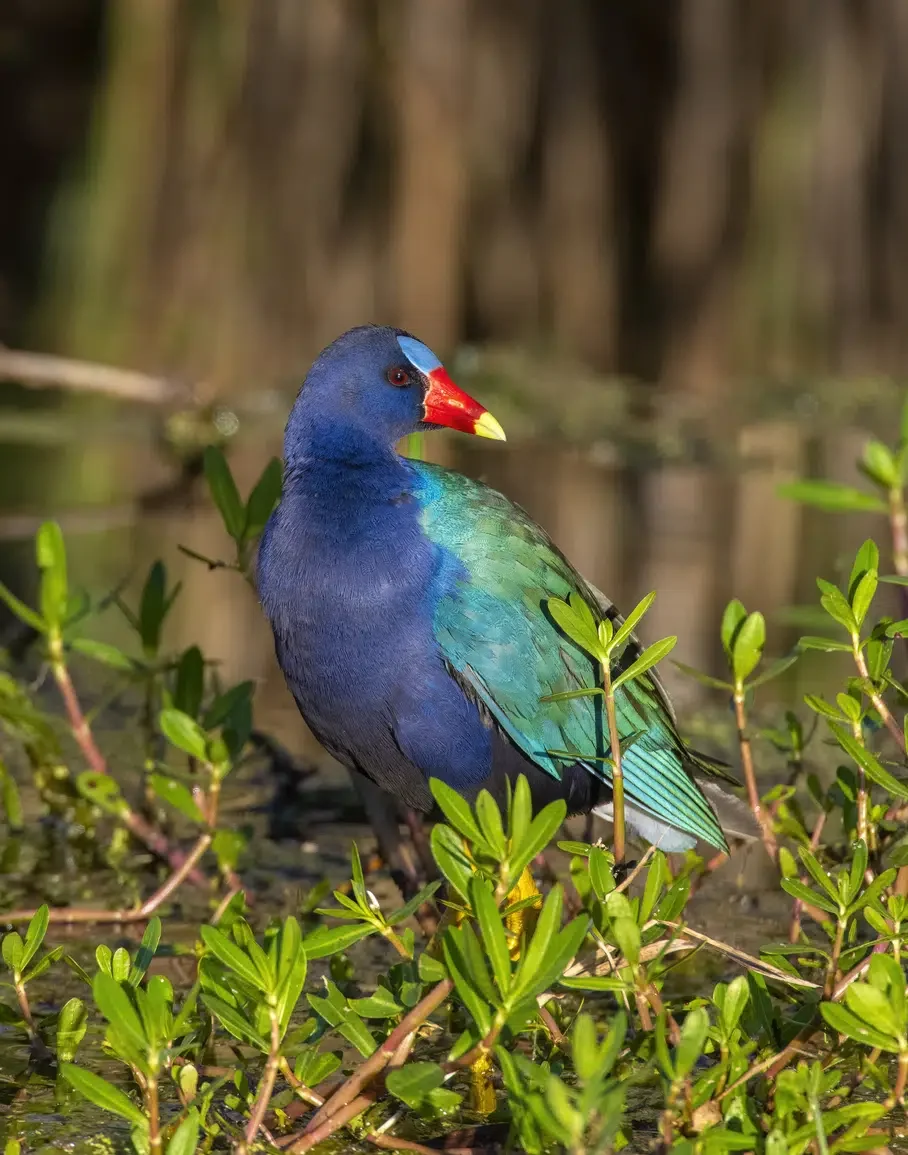
Purple Gallinule sitting along the shore. Photo by David McGowen via iStock by Getty Images
Return Visits to St. Marks National Wildlife Refuge
That first visit to St. Marks National Wildlife Refuge was in 2018. We’ve been back to the St. Marks Refuge many times since; there’s always something different to see. Today, Brown Pelicans and Royal Terns line the rows of pilings poking out of the saltwater at Apalachee Bay – remnants of the lighthouse keeper’s boathouse. I love their tangerine beaks and jet-black crests that appear flippant in the crisp afternoon breeze…the same current of air that sends a shiver through the beds of sea-grass at the water’s edge.
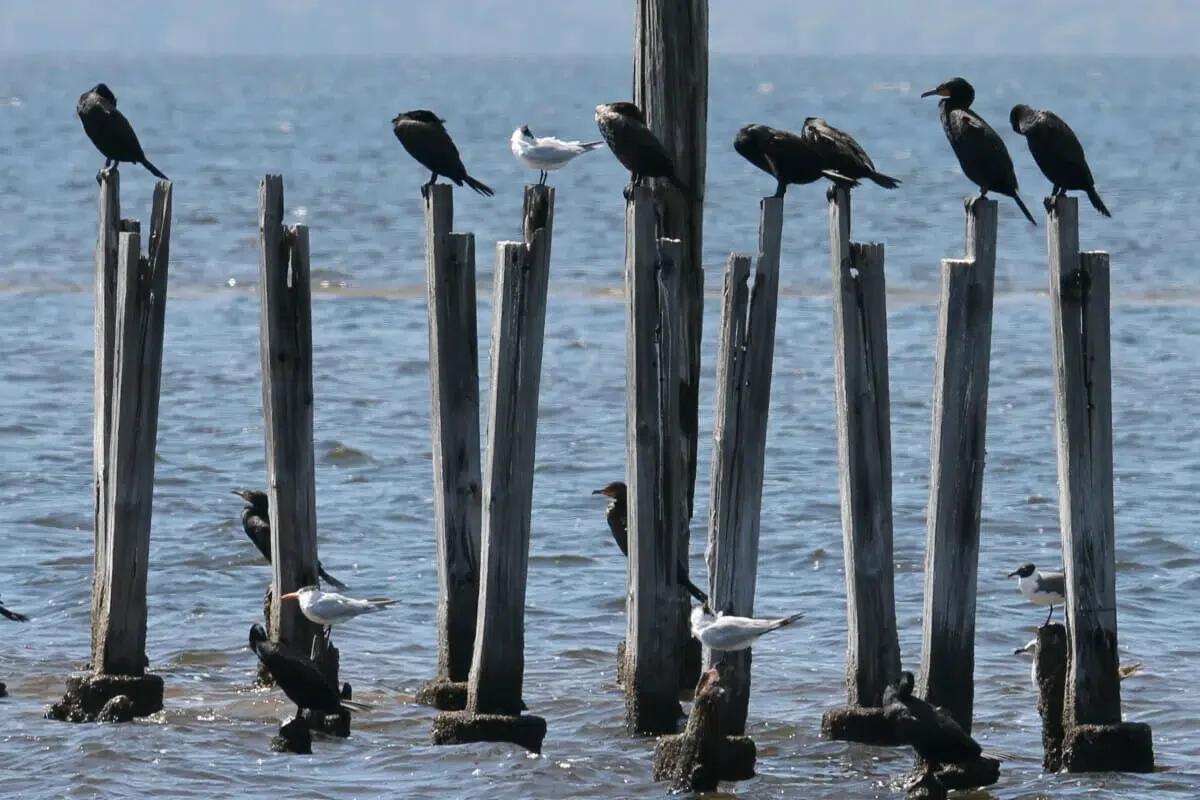
Cormorants, terns, and seagulls sit on pilings next to the St. Marks Lighthouse. Photo by Gustavo Lillo
St. Marks Wildlife Refuge is a Haven for Ducks, Anhingas, and Grackles
Double-crested Cormorants, even an anhinga, are roosting atop the vacant wooden pedestals, their black wings outstretched towards the sky; gradually, the warming rays of sunshine dry their covert feathers. The Lighthouse Levee Trail, a birder’s paradise, winds between the bay and a freshwater pool, home to orange-billed Great Egrets and rose-legged White Ibises. It is also plentiful with ducks—Buffleheads, Green-winged Teals, Northern Pintails.
A Boat-tailed Grackle, with shimmering, glossy-black feathers, perches atop the trailhead sign, while his mate, a smaller, dull-brown version of the male, scuttles across the sand, foraging in the bayside verdure.
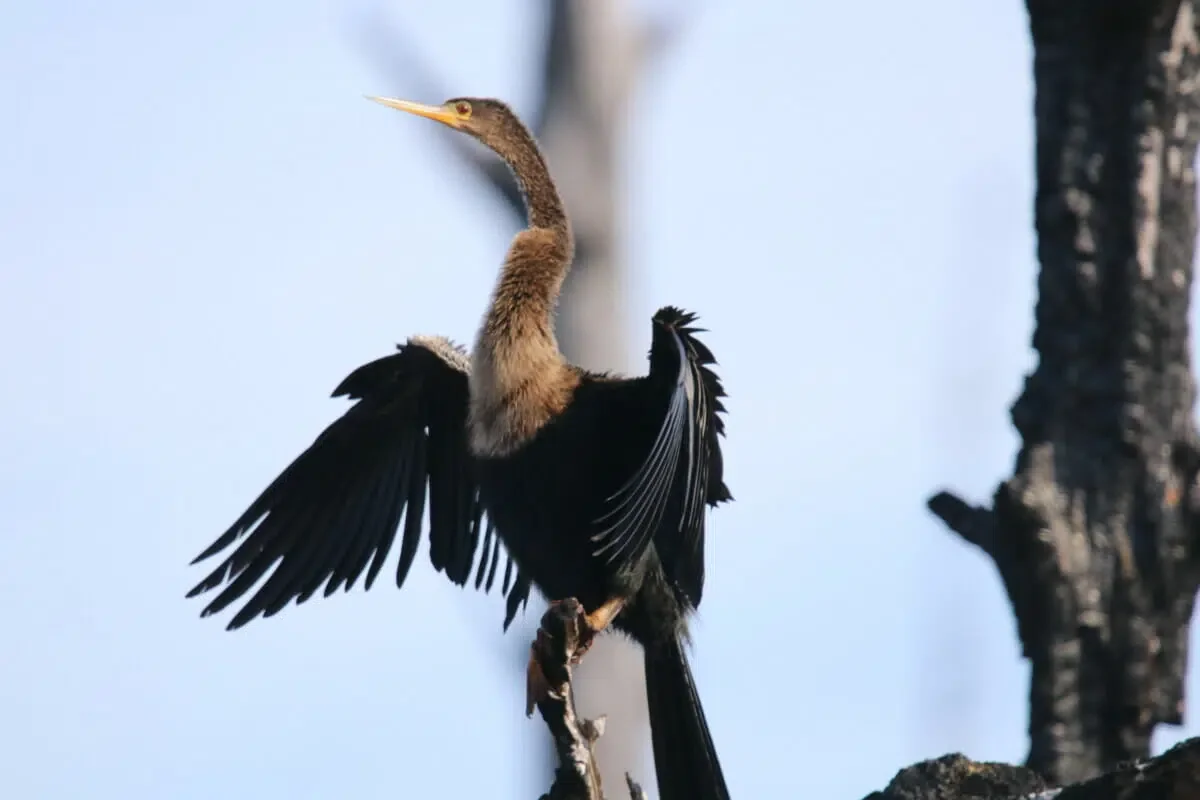
A beautiful anhinga dries its wing on a branch at the Tower Pond. Cormorants, Terns, and Gulls on Pilings next to St. Marks Lighthouse. Photo by Gustavo Lillo
Alligators at the St. Marks Refuge
Birds are the only inhabitants at St. Marks National Wildlife Refuge.
WARNING – ALLIGATORS. The notice flanks the opposing shoreline, alerting hikers and cyclists to the fact that those two large eyes subtly resting atop the water, perhaps camouflaged amongst the widgeon grass or sago pondweed, belong to the modern-day relative of a 37-million-year-old prehistoric reptile.
An alligator—the anglicized version of ‘el lagarto’, meaning ‘lizard’, coined by the first Spanish conquistadores to reach the Florida Peninsula—might just be lurking near the bank. Naturally, those strolling with their four-legged canine friends need to observe extra caution.
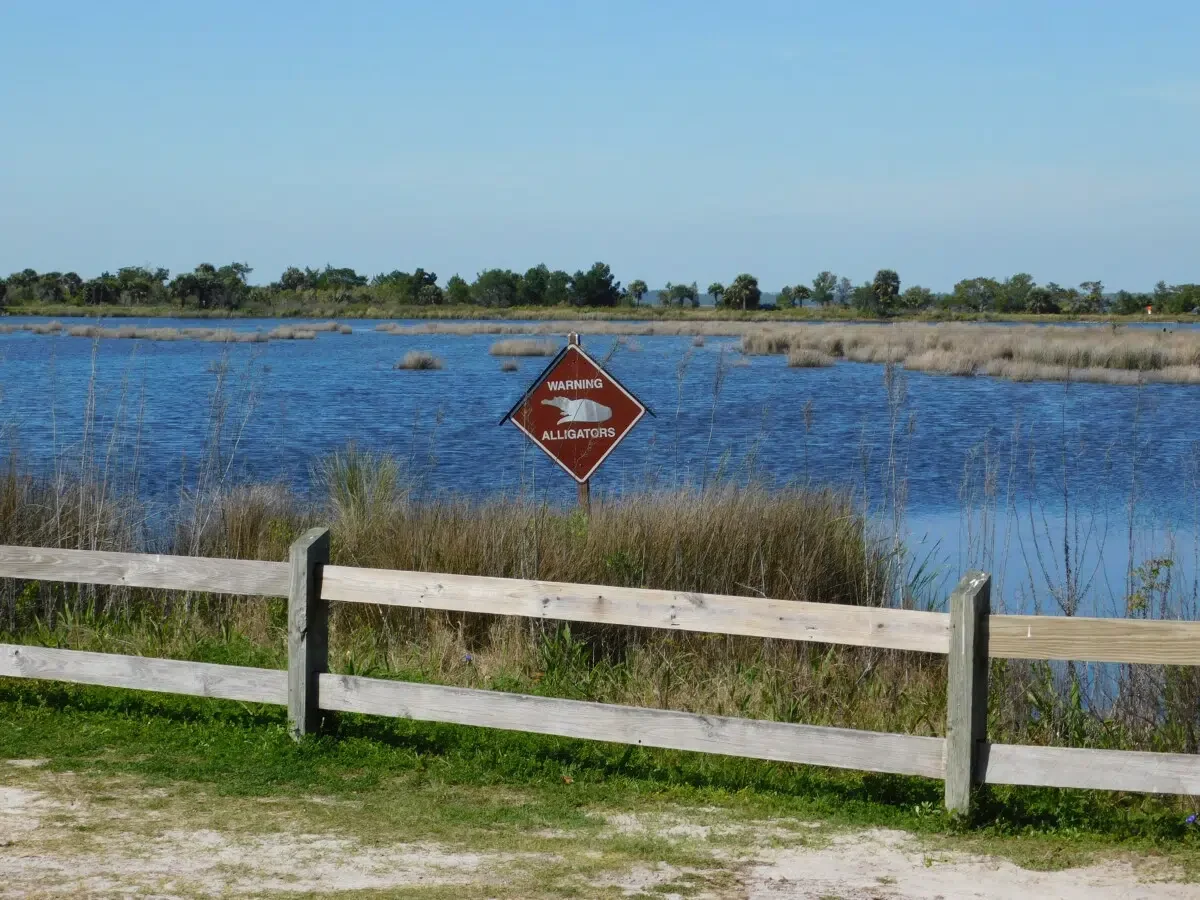
Warning – Alligators sign states the obvious at the Lighthouse Pond at the beginning of the Levee Trail. Photo by Gustavo Lillo
Lighthouse Levee Trail at St. Marks National Wildlife Refuge
Bird-watchers, dog-walkers, a father and son with bamboo fishing poles…and my husband and me…all are heading down Lighthouse Levee Trail. This ¼-mile circuit leads towards a picnic table and small boat jetty. We don’t draw attention to a small cotton mouse hiding in the scrub.
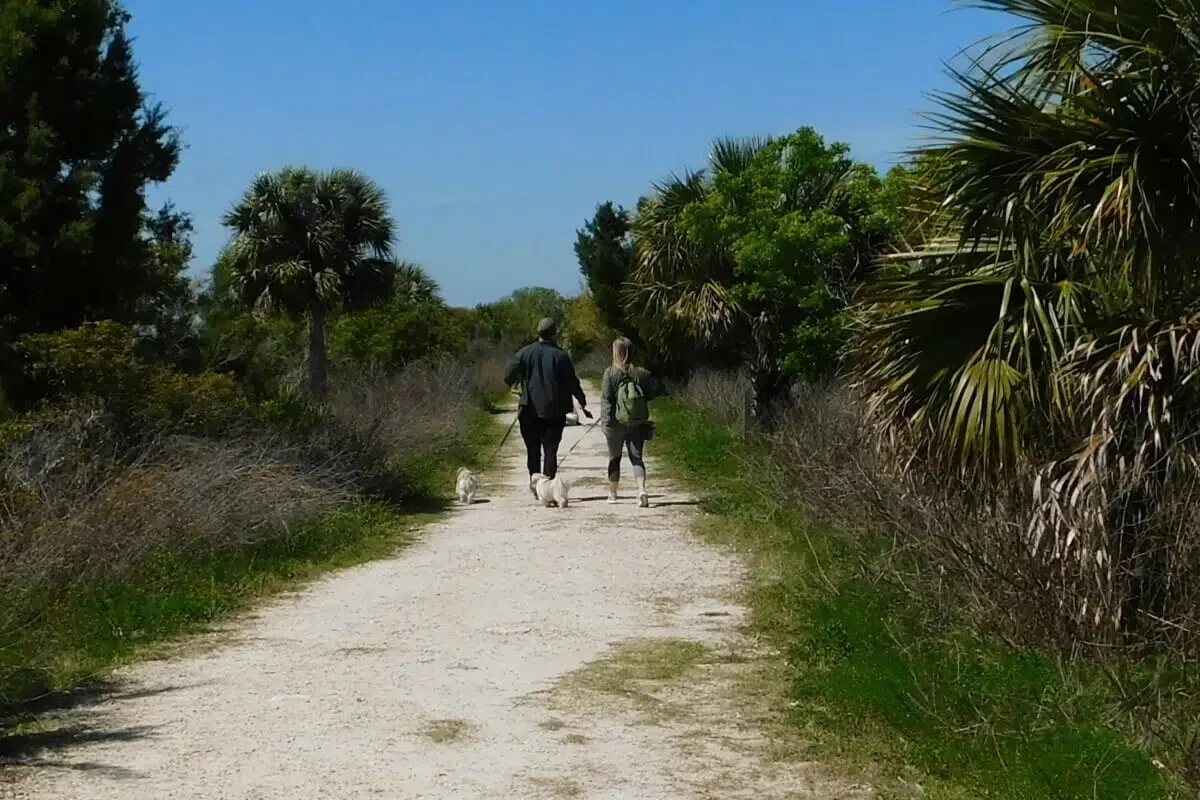
Hikers walk their dogs along the Lighthouse Levee Trail which meanders along Apalachee Bay and the St. Marks River. Photo by Gustavo Lillo
Tree Swallows swoop overhead, faster than the speed of light—or at least, faster than the flash of our camera shutter. Redhead ducks paddle leisurely across the pond, towards the lighthouse. Retracing our steps along the Levee Trail, we encounter a couple on bicycles, and wave to a motorboat slowly puttering towards the St. Marks River. The footpath dumps us out alongside the famous sentinel, the St. Marks Lighthouse, at the convergence with its namesake river and the Gulf.
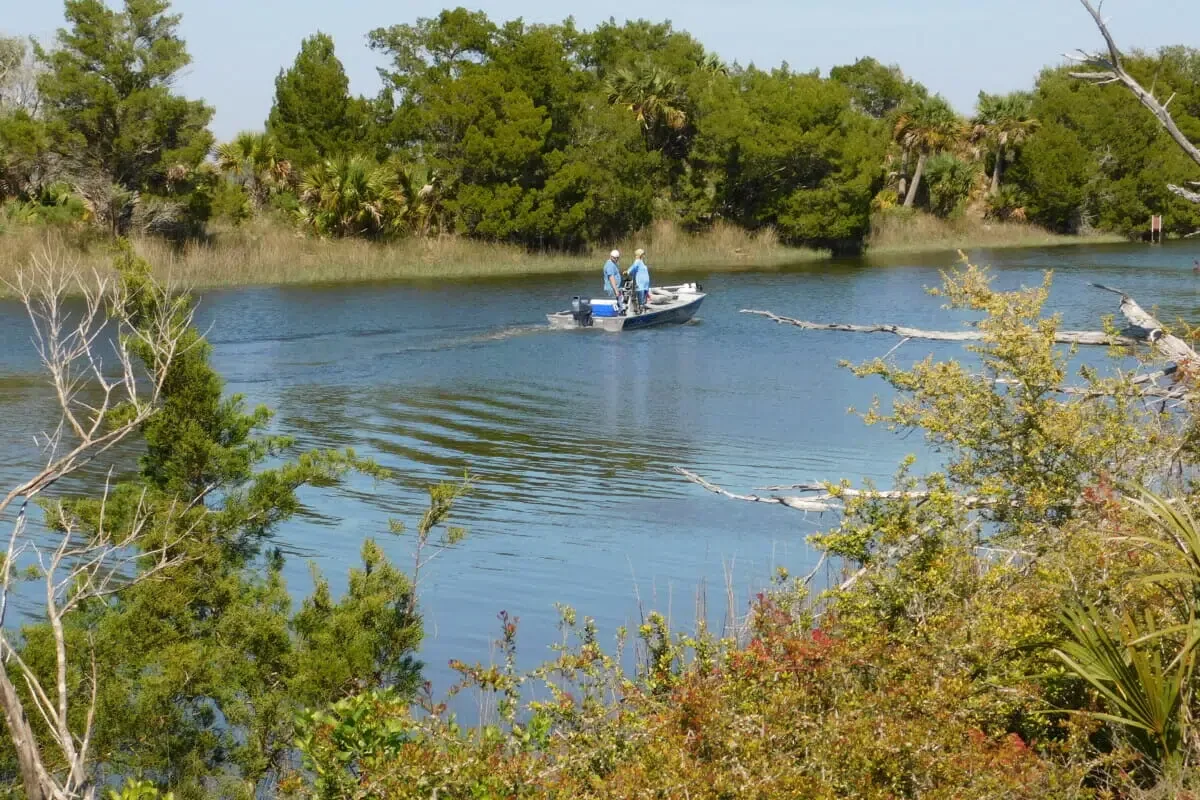
Motorboats putter up the St. Marks River. Photo by Gustavo Lillo
The St. Marks Lighthouse
Authorized by the U.S. House of Representatives in 1828, construction began on the 65-ft. hollow-walled tower. As the second-oldest beacon in the state of Florida, the signal-house hallmarked the St. Marks River entrance, which, at the time, rivaled Pensacola and Jacksonville as a thriving port.
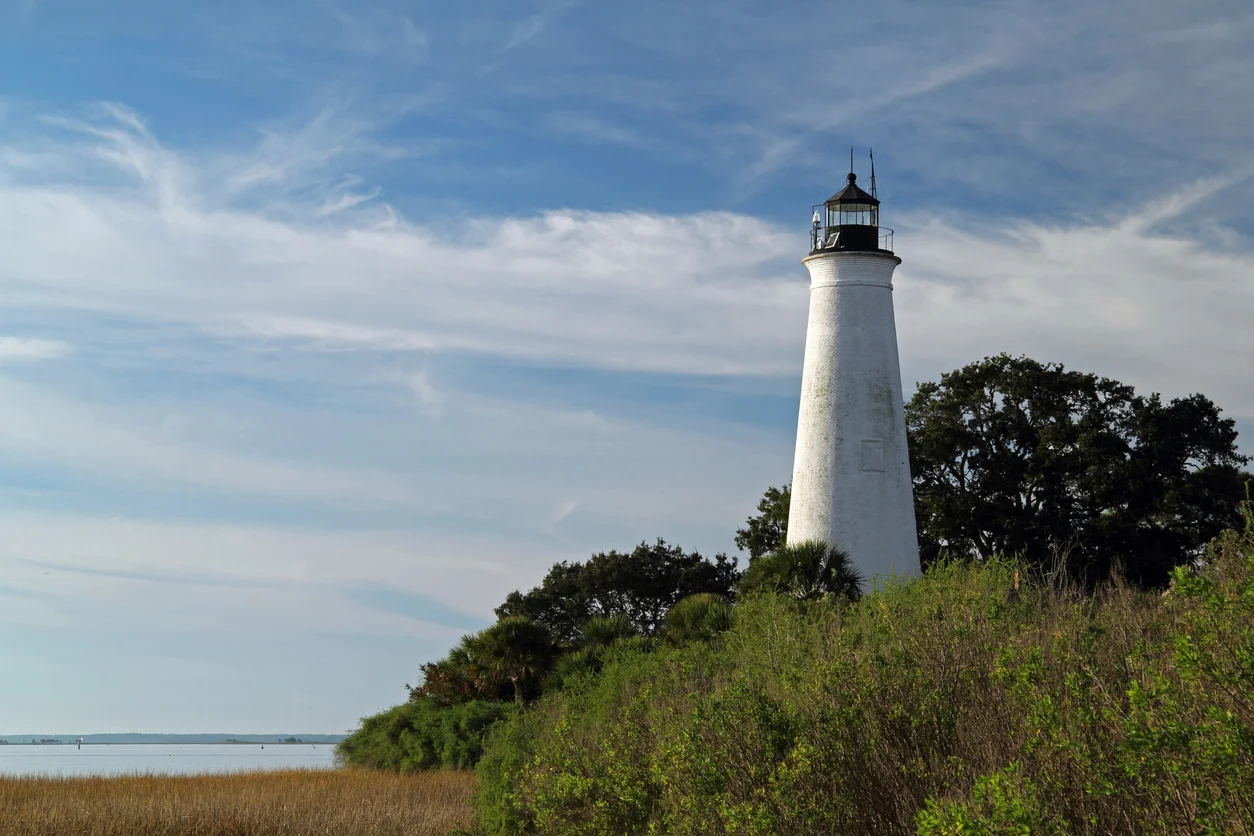
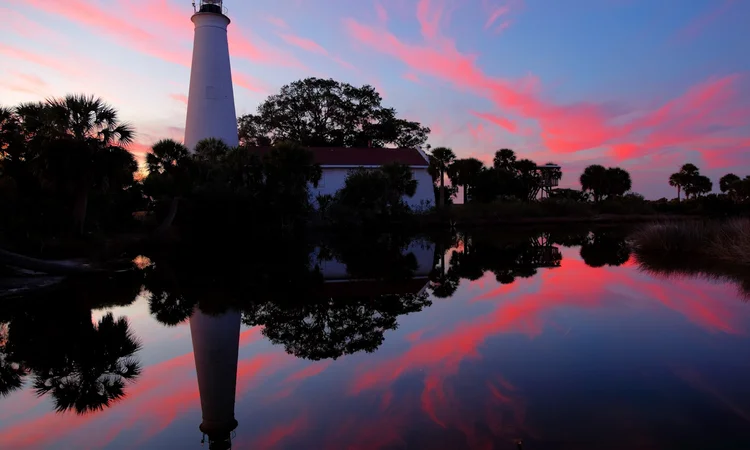
St. Marks Lighthouse, St. Marks National Wildlife Refuge, Florida. Photo by Wilsilver77 via iStock by Getty Images
Early Years of the St. Marks Lighthouse
Finished in 1830, an inspector rejected the hollow walls of the newly completed St. Marks Lighthouse. The inspector instead demanded solid walls. A year later, construction finished on a second tower of mortar, probably near the end of today’s Cedar Point Trail. The initial lighthouse keeper, Samuel Crosby, lit 15 Argand-Lewis lamps, fueled by whale oil, which burned cleaner and 10 times brighter than candle-power.
Inside a decade, that lighthouse deteriorated, its ‘solidity’ unable to fend off the perpetual dampness. Masonry began to break down…bricks crumbled…erosion and foundation settling caused further cracks in the tower’s walls. By 1842, the third—and present—lighthouse was constructed at the termination of County Road 59 on the east side of the entrance to the St. Marks River. Once again, with hollow walls, 88 feet tall, with paneling of a grey beadboard.
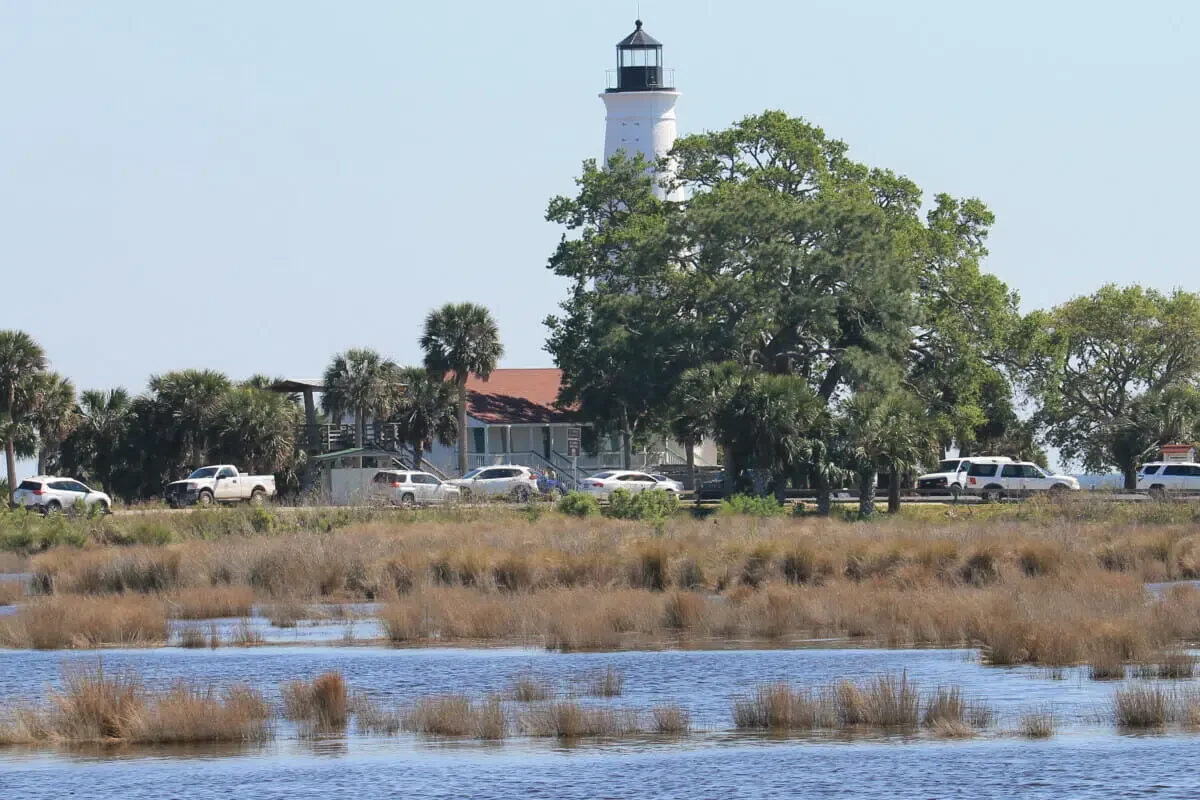
St. Marks Lighthouse view, taken from across the Lighthouse Pond. Photo by Gustavo Lillo
St. Mark’s Lighthouse Survives Wars and Hurricanes
Through the years, the St. Marks Lighthouse has truly weathered the storms, surviving natural disasters (the 1843 hurricane and a Category 3 in 1851 that obliterated the beacons on Dog Island and Cape San Blas), along with man-made tragedies (artillery barrage by a federal fleet of 16 Union Navy ships and a near-miss by a B-17 bomber in late WWII, which crashed during night maneuvers in the nearby marshes). And, of course, the ravages of termites and time.
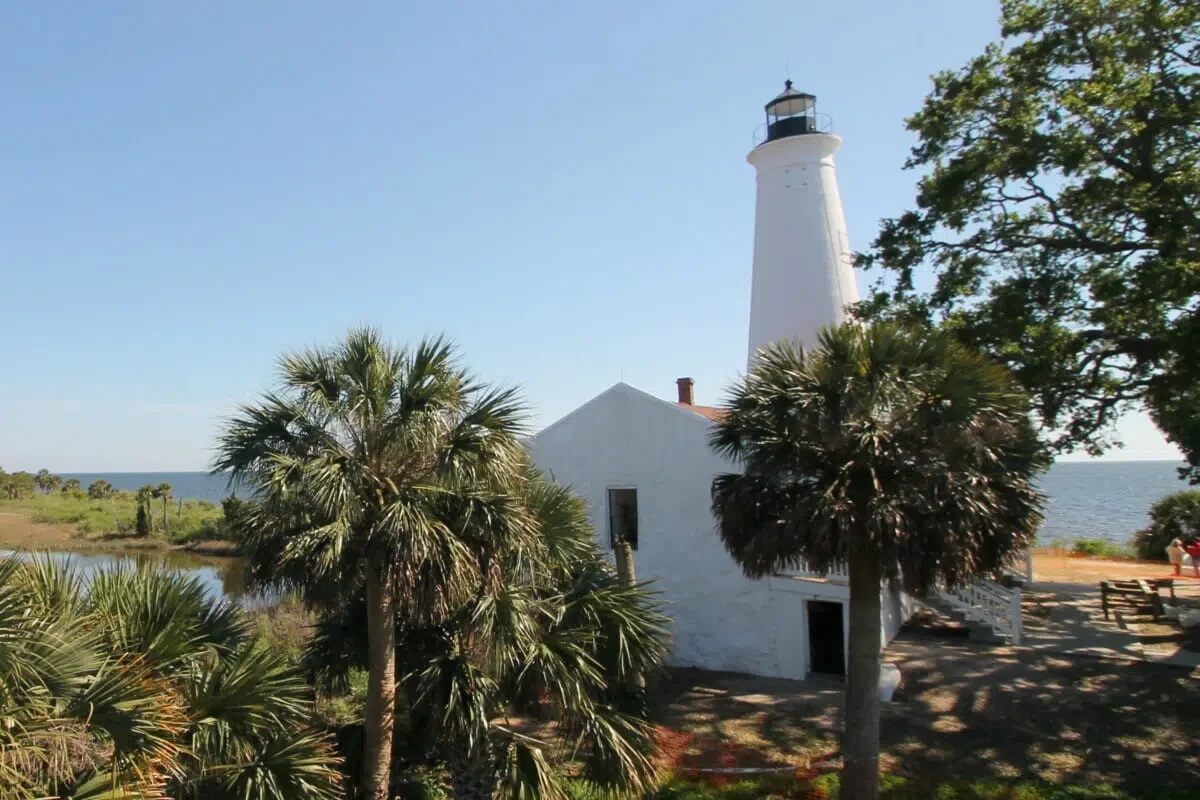
Lighthouse keeper quarters and the St. Marks Lighthouse. That day, there was a good-sized snake crawling up the side of the LHK building. Photo by Gustavo Lillo
Lighthouse Keepers at St. Mark’s Sentinel
While the St. Marks light station reigned supreme, two families lived on the coastal dunes –the lighthouse keeper (LHK) and the assistant keeper. For operating the beacon and helping vessels in distress—which included running fuel out to stranded boaters—keepers earned $600/year average salary, with a supplemental food stipend of beans, flour, port, and sugar. Of course, there was always fabulous fishing in the nearby waters.
Even women applied for the job of the lighthouse keeper. Ann Dudley was the first of only two female watchtower keepers. After her husband died of a heart attack around the time of Florida’s bid for statehood, she petitioned to stay on, remaining for three years (around 1851), raising crops, hogs, and poultry. The only other female LHK, Sarah Fine, arrived in 1892 with her husband. Although he died in 1904, she stayed until 1916.
The last keeper—Alton Gresham—departed the premises in 1951.
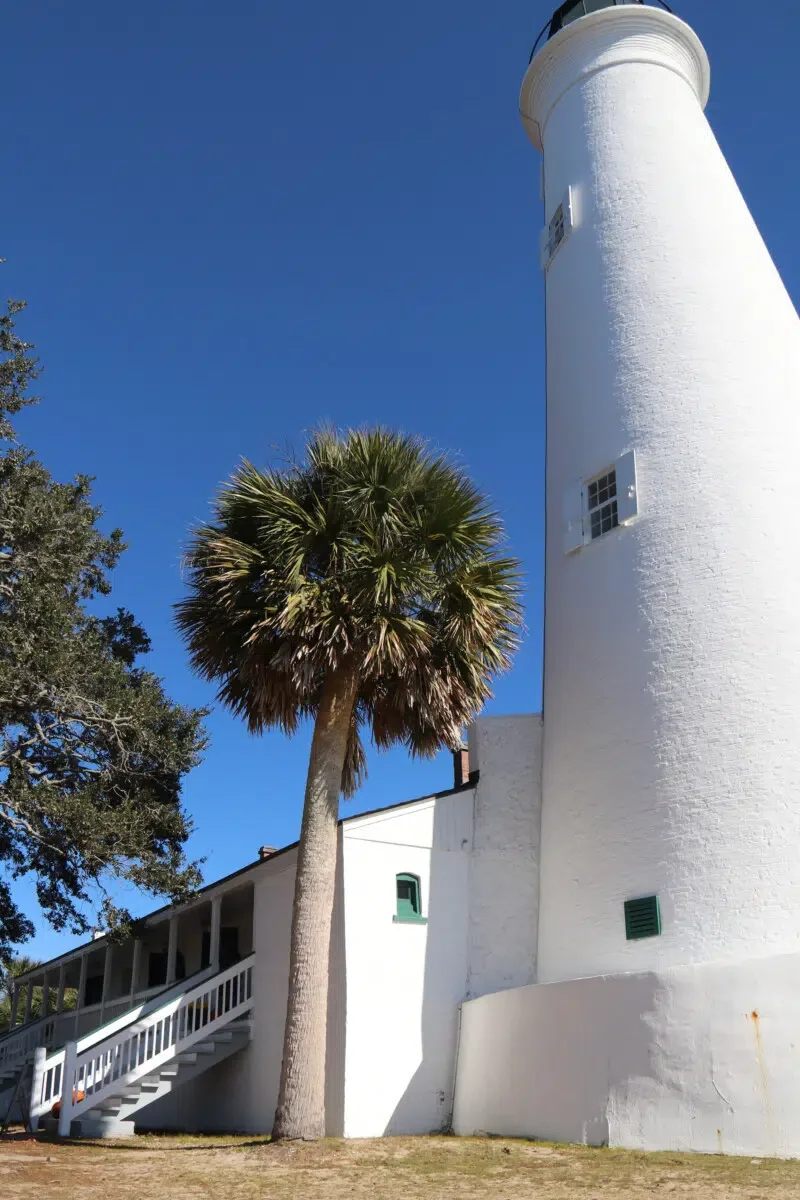
Tower of St. Marks Lighthouse and the attached LHK quarters. Photo by Gustavo Lillo
Old Oak Tree at St. Mark’s Lighthouse
As a newcomer, Sarah Fine transplanted a roughly ten-year-old oak tree in the barrier island’s poor soil (nothing but sand and grass) that should have never survived there, according to geologists. Miraculously, the old oak tree still thrives—almost 130 years later. Gargantuan and robust, the oak overhangs the front yard of the refurbished LHK barracks, restored to 1930s splendor.
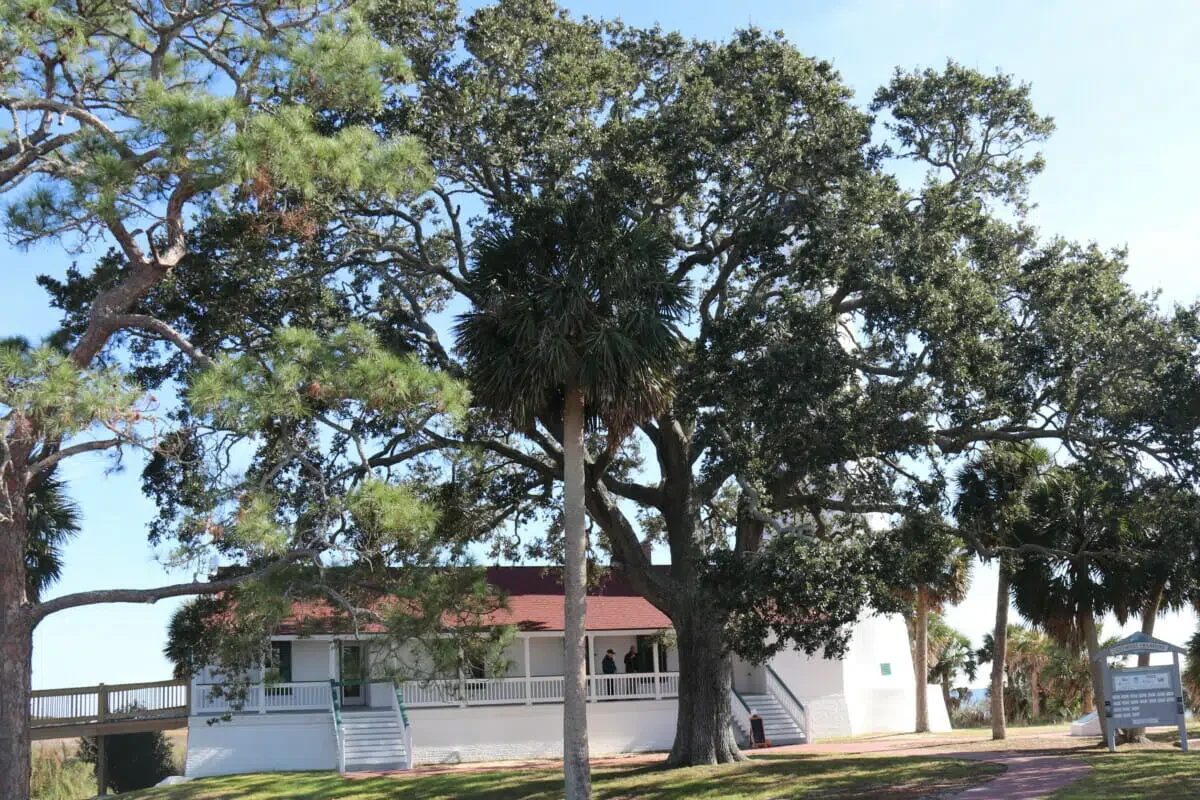
Sarah Fine planted this tree when she arrived at St. Marks with her husband, the lighthouse keeper at the time. It has survived for over 130 years. Photo by Gustavo Lillo
Touring St. Marks Lighthouse
Volunteer LHK guide John Y. Roberts has a special connection to the lighthouse. His grandfather, John Gresham, was one of the numerous lighthouse keepers. “I remember spending my summers here, swimming off of a little dock in the bay, at the mouth of the St. Marks River,” Roberts reminisces.
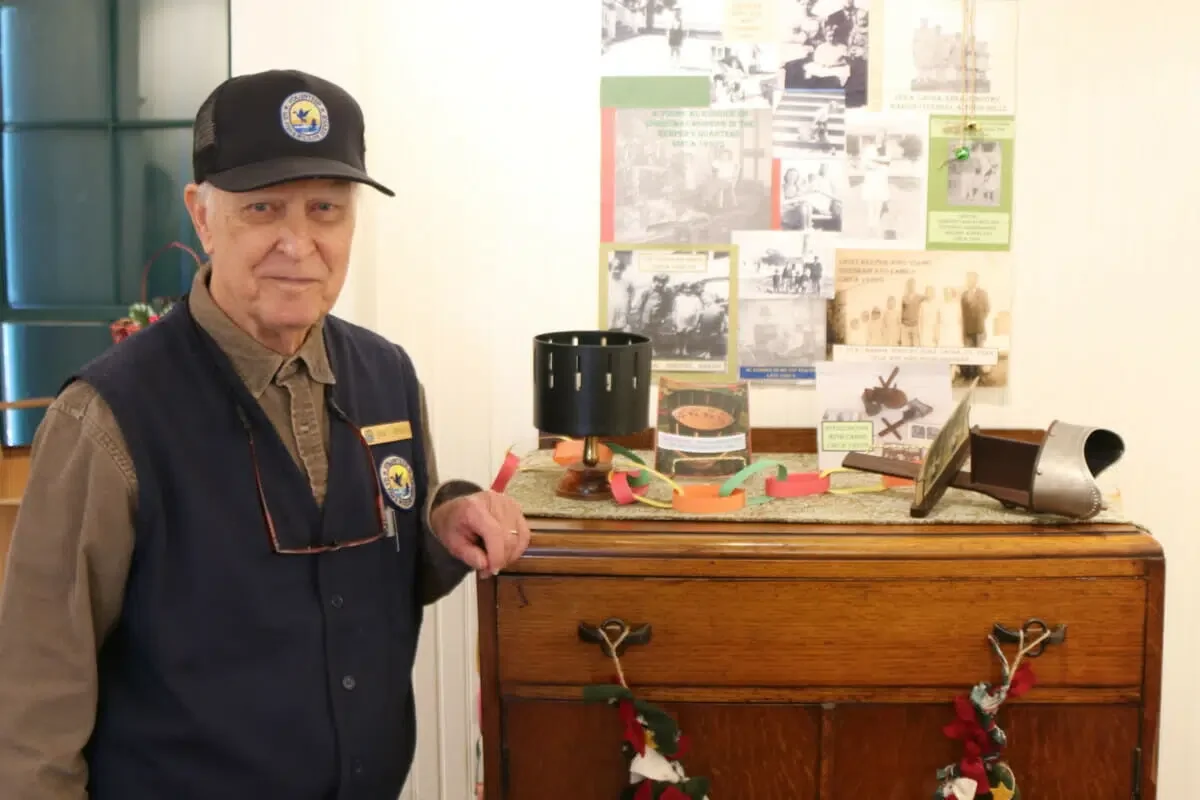
Guide John Y Roberts, the grandson to LHK John Gresham, is pictured by his family photos. Photo by Gustavo Lillo
A Continuing Beacon at Apalachee Bay
The multi-prismed 19th-century Fresnel lens (named after French inventor/lighthouse technology pioneer, Augustin Fresnel) was a six-panel lantern that radiated its beam from the lantern-room platform high above Apalachee Bay, emitting a signal visible 15 miles out to sea.
Although the U.S. Coast Guard replaced the Fresnel lens (which required daily cleaning) with a solar-powered exterior LED light blinking every four seconds in 2000, the signal shines bright, steering vessels to the entrance of the St. Marks River.
I remember Halloween 2019. Observance of the St. Marks National Wildlife Refuge’s 88th birthday included a re-lighting ceremony of a replica fourth-order Fresnel lens for the historic lighthouse. A narrow line of squalls easing in from the west was threatened to disrupt the evening festivities. Luckily, the gala went off without a hitch.
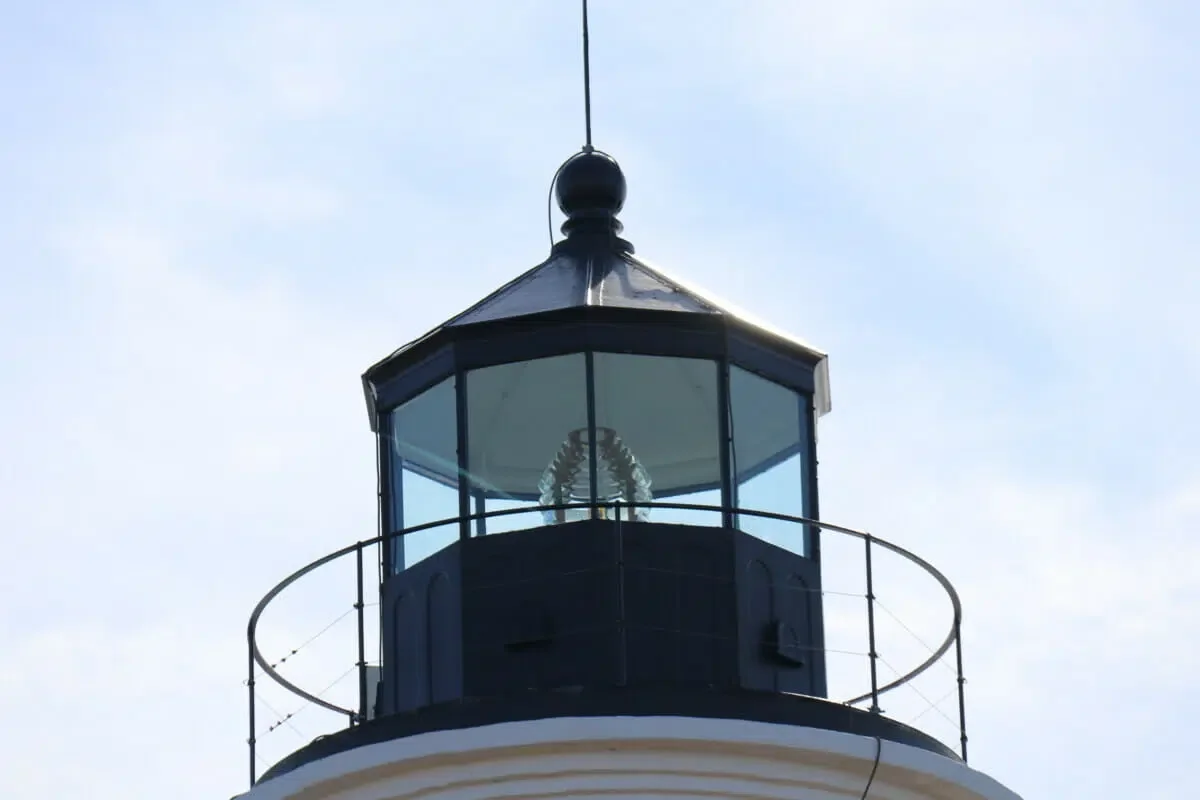
St. Marks Lighthouse beacon with Fresnel lens, as it looks today. Photo by Gustavo Lillo
Original Fresnel Lens on Display at St. Marks Wildlife Refuge
The original lens, which housed a kerosene lamp, was dismantled during the Civil War, to prevent Union soldiers from taking it. Chipped slightly while being absconded down the tower steps, the lantern was hidden in the swamps until the CSS Spray, a Confederate blockade runner, hauled it away. That luminary is on prominent display inside the visitor center at the Refuge, permanently decommissioned, like so many other seafaring lamps.
“There’s no real need for lighthouses anymore since ships are using GPS systems for navigation,” confides T. J. Cutchins, a volunteer giving $2 tours of the Keepers’ Quarters.
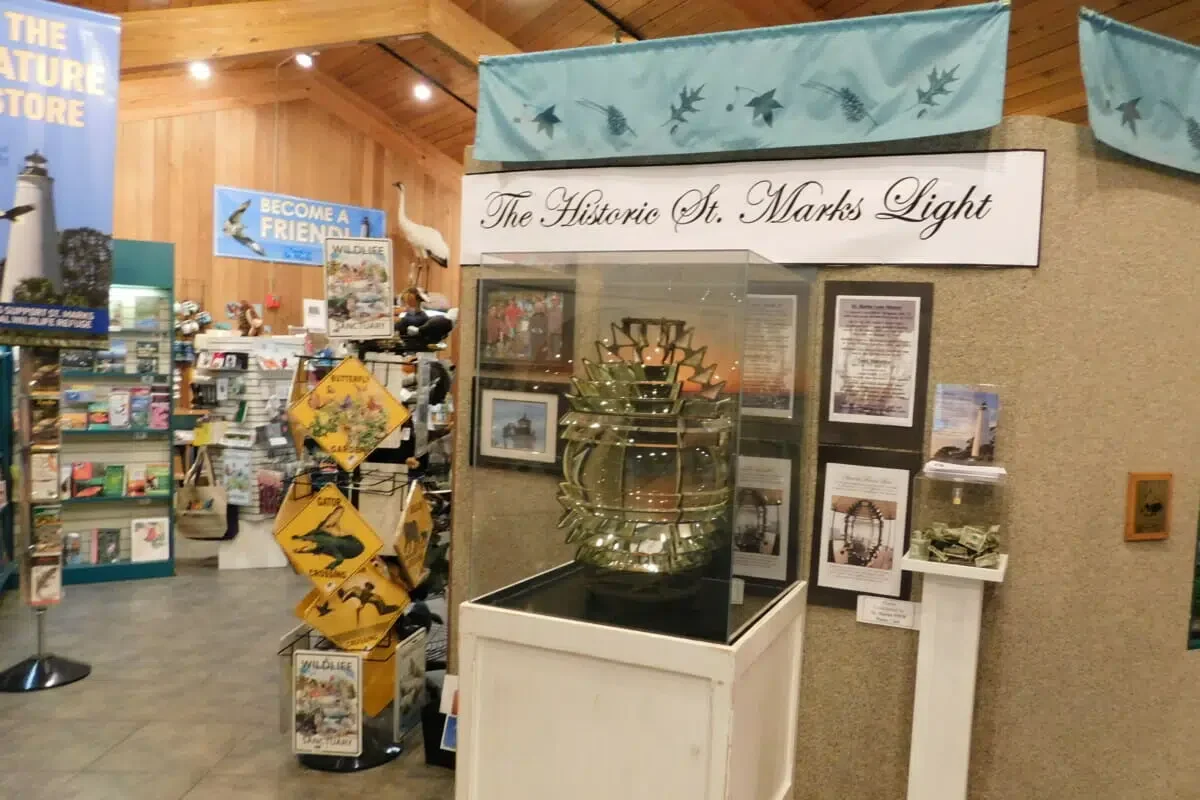
The historic Fourth-Order Fresnel lens sits on display in St. Mark’s Wildlife Refuge’s gift shop. Photo by Gustavo Lillo
Despite the lack of demand for these nautical Phares, re-lighting the lens is of significance to the local communities, especially for those interested in maritime heritage. Barely over a year after Hurricane Michael’s ferocious gusts blanketed the lighthouse in salt, blew away the steps, and stripped most of the leaves from the sanctuary’s trees, the beacon has been re-lit and currently burns bright.
Articles Related to St. Marks National Wildlife Refuge in Florida
Sanibel Sundial Beach Resort & Spa
10 Best Beach Vacation Escapes
Hotel Profile: Hilton Clearwater Beach
Find the Best Birdwatching in Texas on Mustang Island
Fun Things to Do Around Fort Myers Beach
Discover Wakulla Springs State Park
A Last Glance at the Wildlife Reserve at St. Marks
We retreat down the Lighthouse Road, passing the salt marshes…surrounded by black-needle rushes and interspersed by islands of towering pines. As daylight wanes and the late-afternoon sun begins to sink below the horizon, we hear the grunts of pig-frogs and the growl of a bull gator nesting in the sedge—the voices of nature resounding across acres and acres of aquatic marsh grass.
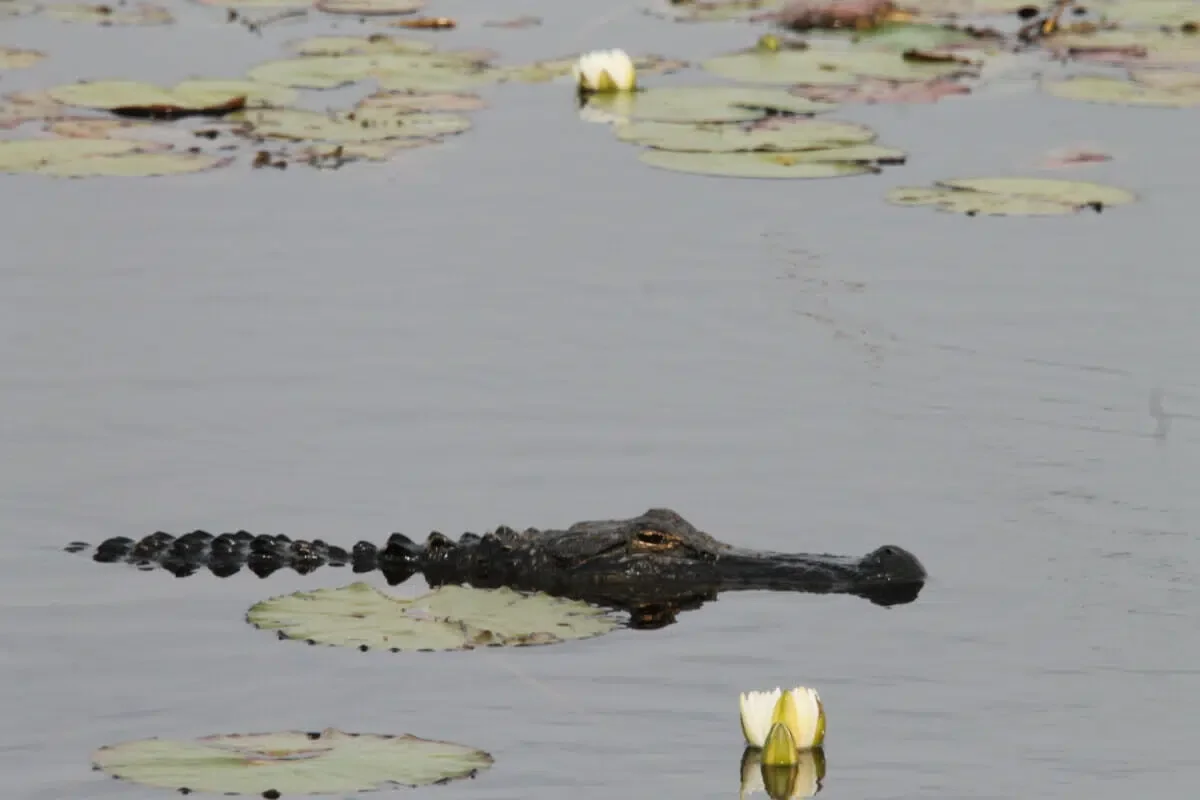
An alligator eases amongst the blooming lily pads in the Tower pond. Photo by Gustavo Lillo
I have enjoyed my many visits to St. Marks National Wildlife Refuge. Admittedly, I still can’t tell the Marbled Godwits from the willets, skittering across the tidal flats, or a Royal Tern on a pillar from a Forster’s…but I can identify herons, egrets, storks, and a few webbed-footers. Besides, I still have my Florida birder’s guidebook to consult; it’s even starting to get a little worn. Be sure to check out Wander for more great ideas on what to see and do when you visit Florida—and other fun outdoor adventures.




Leave a Reply
Your email address will not be published.